 Saint Martin of Tours was born in the fourth century to pagan parents in Sabaria, comprising parts of modern day Yugoslavia and Hungary. His father was an officer in the Roman army. His family moved to Pavia in Italy when he was still a child. And there the boy first learned of Christianity, felt drawn to it, and became a catechumen. Afraid of the reaction from his parents and also of the largely pagan community, Martin kept his love of Christ hidden. Following his dad's footsteps, young Martin joined the Roman army at the age of fifteen. He was stationed in Gaul during a winter season. One day while riding into the city, he noticed a beggar near the city gates. The poor man was shivering with cold and had turned almost blue. Martin had no money to give him, but had a very heavy woolen cloak to keep himself warm. So he divided the cloak in two pieces, gave one half to the beggar, and barely wrapped himself with the other half. This kind act by the young man immediately caused a big scandal among his peers and the town folks. They realized Martin was a Christian.
Showing posts with label Saints. Show all posts
Showing posts with label Saints. Show all posts
Monday, November 11, 2013
Causing Scandal
Saint Martin of Tours was born in the fourth century to pagan parents in Sabaria, comprising parts of modern day Yugoslavia and Hungary. His father was an officer in the Roman army. His family moved to Pavia in Italy when he was still a child. And there the boy first learned of Christianity, felt drawn to it, and became a catechumen. Afraid of the reaction from his parents and also of the largely pagan community, Martin kept his love of Christ hidden. Following his dad's footsteps, young Martin joined the Roman army at the age of fifteen. He was stationed in Gaul during a winter season. One day while riding into the city, he noticed a beggar near the city gates. The poor man was shivering with cold and had turned almost blue. Martin had no money to give him, but had a very heavy woolen cloak to keep himself warm. So he divided the cloak in two pieces, gave one half to the beggar, and barely wrapped himself with the other half. This kind act by the young man immediately caused a big scandal among his peers and the town folks. They realized Martin was a Christian.

Thursday, June 13, 2013
Tony, Tony, Turn Around. Something's Lost

Friday, January 25, 2013
Saul's Horse and St. Paul's Race
 |
| Conversion of St. Paul by Caravaggio |
I will be the first one to admit and the last to realize that I am no Bible expert. I am still confused how to perceive what I read in the Bible - whether it is literal or figurative. But when it comes to Saul's fall, I have no doubt that a horse was involved; not a literal one, but a figurative one. And how do I know this? I know because it takes one to know one; I too have fallen off the horse.
Friday, December 28, 2012
The Fear of Losing
 King Herod could be a perfect icon for fear. It would be an understatement to say that he ruled Israel and Judea with an iron fist - an iron heart would be more appropriate. If you look for the cause for him to spread fear among everybody associated, the reasoning will bring you back to where you started - fear. In fear Herod kept everybody under fear to maintain his power and possessions, and to achieve more. This fear compelled him to murder one of his wives, one brother, several brother-in-laws, and three of his sons. This fear also enabled him to command his soldiers to slaughter all kids two years and younger in and around Bethlehem. The Church today remembers those innocent lives lost as the Feast of the Holy Innocents - the first martyrs in the name of Christ.
 Thursday, December 27, 2012
The man who defined God!
 The Bible, in an effort to help us better understand God, personifies Him. So we see many sides of His persona throughout the Bible - the Creator, the Provider, the Protector, the Liberator, the Healer, the Lover, the Punisher, the Redeemer, and so on. In line with the Bible, the Catholic church also profess the Doctrine of the Holy Trinity, which is defined as three persons - the Father, the Son and the Holy Spirit- in one God. But what is God, what is it that makes God who He is?
Wednesday, December 26, 2012
The day after Christmas
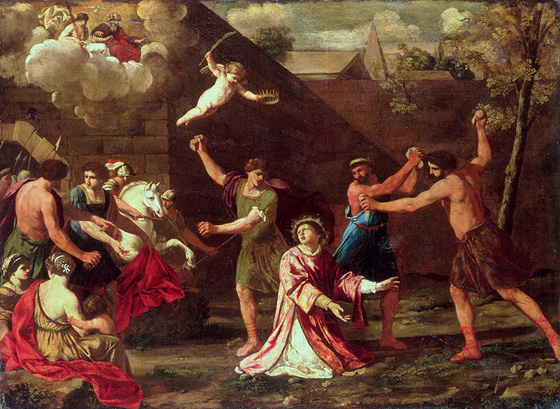 A day after celebrating the birth of Prince of Peace, the Church today commemorates the martyrdom of St. Stephen. It immediately establishes the connection between Bethlehem and Calvary - the stark realities of life: birth, happiness, sufferings, and death. I must say that it is also a good way of remembering Jesus' words, "Do not think that I have come to bring peace upon the earth. I have come to bring not peace but the sword" (Matthew 10:34). A rather controversial statement coming from the Incarnation of an all-loving God. But 2000 years removed from when He said it, we should now know what it meant. And don't assume He was prophesying about many wars and atrocities that happened in the name of Jesus - that was not God, that was just arrogant humans taking up God's name for their own benefit.
 Thursday, December 13, 2012
I failed to see the "Light" in Lucy

Friday, November 30, 2012
The First One Called

Tuesday, November 27, 2012
Mother Teresa and Divine Providence

Thursday, October 18, 2012
Meet Doctor Luke
_-_James_Tissot.jpg)
- Luke was believed to be born a Greek and a Gentile.
- Luke was a physician as evident from St. Paul's words, "Luke, the beloved physician" (Colossians 4:14). He is the patron saint of physicians and surgeons.
- Many scholars believe that Luke might have been born a slave. It was not uncommon for families to educate slaves in medicine so that they would have a resident family physician.
- Of the four Gospel writers - Matthew, Mark, Luke and John - Luke is the only one believed to have never walked with Jesus. Though Mark was also not among the twelve disciples of Jesus, it is believed that Mark was a follower of Christ, since his cousin Barnabas was the one who was not chosen to replace Judas Iscariot by the drawing of the lot (Acts 1:23-26).
- Though not much known about the conversion of Luke into Christianity, it is evident from the Acts that Luke followed St.Paul in his ministry. It is widely believed that he joined Paul in Acts Chapter 16. Up until Acts 16:8, the Acts is written in the third person as a historian recording facts. But, suddenly from Acts 16:10 onwards, the language changes, "they" becomes "we", suggesting that the writer became an active participant rather than an observant from that point on.
- During the final imprisonment and sufferings of Paul, Luke was the only one remained with Paul while all others deserted him, "Only Luke is with me" (2 Timothy 4:11).
- Luke took a different route than the other three in writing the Gospel. Since he had no personal knowledge of Jesus and his activities, Luke followed the inspirations of the Holy Spirit to "investigate everything carefully from the very first, to write an orderly account" (Luke 1:3).
- Luke's is the Gospel of the poor and of social justice. He uses "Blessed are the poor" (Luke 6:20) instead of "Blessed are the poor in spirit" in beatitudes. He is the one who tells the story of Lazarus and the rich man who ignored him (Luke 16:19-31). He also is the only one who talks about the "Parable of the rich fool" (Luke 12:16-21). Through him, Jesus also encourages giving away possessions in order to be Saved, "Give alms, and behold, everything will be clean for you" (Luke 11:41).
- Forgiveness and God's mercy to sinners is also of importance to Luke. Only in Luke do we hear story of the Prodigal Son (Luke 15:11-32) and the story of the forgiven woman disrupting the feast by washing Jesus' feet with her tears (Luke 7:36-38).
- Luke's gospel also shows special sensitivity to evangelizing Gentiles. It is only in his gospel that we see the Parable of the Good Samaritan (Luke 10:25-37), that we hear Jesus praising the faith of Gentiles such as the widow of Zeraphath and Naaman the Syrian (Luke 4:25-27), and we witness the story of one grateful leper who is a Samaritan (Luke 17:11-19).
- Luke also has a special connection with Mother Mary. There is no doubt that "while investigating everything carefully from the very first" (Luke 1:3), he must have paid a visit to Mother Mary to know more about how did it all started. It is only in his gospel that we hear the story of Annunciation, Mary's visit to Elizabeth, the Magnificat, the Presentation and the story of Jesus' disappearance in Jerusalem.
- Last but not least, it is Luke that we have to thank for the Scriptural parts of the 'Hail Mary', one of the most beloved prayers among Catholics all over the world: "Hail Mary, Full of grace! The Lord is with you" (Luke 1:28) spoken by the Angel at the Annunciation, and "Blessed are you and blessed is the fruit of your womb" (Luke 1:42) spoken by her cousin Elizabeth.
Friday, September 21, 2012
The Calling of Saint Matthew

Today, the Church celebrates the Feast of St. Matthew, Apostle and Evangelist. "As Jesus passed on from there, he saw a man named Matthew sitting at the customs post. He said to him, 'Follow me'. And he got up and followed him" (Matthew 9:9)
The Calling of Saint Matthew is a masterpiece by Michelangelo Merisi da Caravaggio, depicting the moment at which Jesus Christ inspires Matthew to follow him. It was completed in 1599-1600 for the Contarelli Chapel in the church of the French congregation, San Luigi dei Francesi in Rome, where it remains today.
The event is depicted here as dramatic, but nearly silent. The tax collector Levi (St.Matthew) is seated at the table with his four assistants, counting the day's proceeds. Jesus, with His halo the only hint of divinity, enters with St. Peter. With a gesture of His right hand, he summons Levi. A surprised Levi points to himself with his left hand as if to say "Who, me?" The armed young man close to Peter is leaning forward as if to question their reason for being there. Peter firmly gestures his right hand as if to say, "Stay out of this, young man. Let my master sort this out with your master". At the time it was drawn, this painting faced severe criticism because Jesus was not on the center of the drawing, and also because of the contemporary French style costumes of those sitting around the table.
The dramatic point of the picture is that for this moment, no one does anything. Christ's appearance is so unexpected and His gesture so commanding as to suspend action for a shocked instant, before reaction can take place. In another second, Levi will rise up and follow Christ; in fact, Christ's feet are already turned as if to leave the room. The particular power of the picture is in this cessation of action, the characteristic human indecision after a challenge or command, and before reaction. The costumes reinforce the situation. Levi and his subordinates, who are involved in affairs of this world, are dressed in a contemporary mode, while the barefoot Christ and Saint Peter, who summon Levi to another life and world, appear in timeless cloaks. The two groups are also separated by a void, connected literally and symbolically by Christ's hand.
The painting has so much meaning because it allows each one of us to be in the center of it, with Jesus standing on the side with His Church calling us to leave the earthly matters and to follow Him, to follow what really matters. Jesus doesn't care who we are or what we do, "I didn't come to call the righteous but sinners" (Matthew 9:13). The two figures on the left do not even notice Christ's arrival; they are too much into this world's affairs and their inattention deprives them the opportunity Christ offers for eternal life. What would our reaction be, if it was us sitting around that table? Levi never looked back once he got up answering the call.
"No one who sets a hand to the plow and looks to what was left behind is fit for the kingdom of God" (Luke 9:62)
Subscribe to:
Posts (Atom)